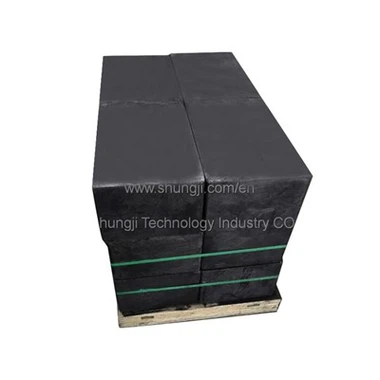
Differences Between Medium Grained Graphite, Molded Graphite and Isostatic Graphite
Jun 06, 2024
Special graphite is a high-performance material with a wide range of applications. Based on particle size and forming methods, special graphite can be classified into several different types. The following details the differences between medium-coarse graphite, molded graphite, and isostatic graphite.
Particle Size
- Fine-structured graphite: Small particles, typically used for precision machining and high-performance applications.
- Medium-coarse structured graphite: Relatively larger particles, suitable for general industrial uses.
Forming Method
- Molded graphite
- Isostatic graphite
- Extruded graphite
- Vibration graphite

Molded Graphite
Fine Grained Graphite

Isostatic Graphite
Fine Grained Graphite

Extruded Graphite
Medium Grained Graphite

Vibration Graphite
Medium Grained Graphite
What Are the Differences Between Medium-Grained Graphite, Molded Graphite, and Isostatic Graphite?
Medium Grained Graphite
- Forming Methods: Mainly includes extruded graphite and vibration graphite.
- Physical Characteristics: Grain size ranges from 0.8 to 2.0 mm, with a density of approximately 1.73 g/cm³. The particles are relatively coarse, and the surface is rough.
- Product Specifications: Generally weighs over 700 kg, with common specifications such as 500×500×1800 mm and 650×500×1800 mm.
- Applications: Primarily used in the chemical industry and metal smelting.
- Price: Generally lower in cost.
Molded Graphite
Physical Properties: Grain size ranges from 9 to 25 μm, with a density of approximately 1.86 g/cm³. The particles are fine and the graphite blocks surface is smooth, exhibiting "anisotropy."
Specifications: Product sizes are relatively small, generally weighing under 200 kg. Common sizes include 550×410×250 mm, 610×510×250 mm, and 910×310×310 mm.
Applications: Widely used in semiconductors, synthetic diamonds, metal smelting, lithium batteries, and photovoltaics (polycrystalline silicon production consumables).
Price: Mid-range price.
Isostatic Graphite
Physical Properties: Particle size ranges from 5 to 15 μm, with a density of approximately 1.86 g/cm³. The particles are fine and graphite surface is smooth, exhibiting isotropy.
Product Specifications: Product sizes are relatively large, with common specifications including 1200×640×270 mm, 1600×670×300 mm, and 620×520×250 mm.
Applications: Mainly used in semiconductors, photovoltaics (monocrystalline silicon production consumables), and electric discharge machining (EDM) in high-precision fields.
Price: Generally higher compared to medium-coarse and molded graphite.
*The above properties are typical values, not guaranteed, other specifications are available.
Company Introduction
Dalian Shungji Technology Industry Co., Ltd specializes in the research, production, and sales of special graphite materials. We possess integrated production and processing capabilities, including calcining, grinding, kneading, baking, and graphitization. The manufacturing of special graphite materials involves multiple production steps and complex processes, along with a significant demand for continuous product innovation and research and development.
We have a highly skilled R&D and production team with extensive practical experience and strong collaboration abilities. This allows us to stay ahead of industry trends and continually develop new graphite materials to meet the high-quality raw material demands of downstream graphite product industries.
Through this detailed introduction to the differences and applications of medium-coarse structured graphite, molded graphite, and isostatic graphite, we hope to provide you with useful insights for selecting the appropriate graphite materials. Should you have any needs or questions, please feel free to contact us.