Graphite in Float Glass: Process & Performance
Jun 30, 2025
Introduction
At SHJ-CARBON, we've partnered with float glass manufacturers around the world to provide high-quality graphite materials that deliver stability, precision, and long-lasting performance in extreme environments. Whether it's supporting molten glass during forming or maintaining dimensional accuracy at high temperatures, graphite plays an essential-but often overlooked-role in ensuring smooth, efficient production. With decades of expertise in graphite engineering, we understand the unique demands of float glass processes and tailor our solutions to meet them. In this article, we'll explore how graphite materials are used throughout the float glass workflow.

Principles of Float Glass Process
The float glass process is the mainstream technology for flat glass production in the world. It was invented by the British Pilkington Brothers in 1959. This process can produce high-quality flat glass with a flat surface and no grinding or polishing. Its basic principle is to continuously flow molten glass from a melting furnace into a tin tank containing molten tin. Since the density of the glass liquid (about 2.5g/cm³) is less than the density of the tin liquid (about 7.3g/cm³), the glass liquid floats on the surface of the tin liquid. Under the combined effect of gravity and surface tension, the glass liquid naturally flattens to form a uniform glass ribbon, and after cooling, it forms a flat glass plate.
The float glass production line mainly consists of a melting furnace, a tin bath, an annealing furnace and cutting equipment. The tin bath is the core equipment for float glass production and is used to complete the glass liquid forming process. In the tin bath, it is necessary to maintain a high temperature (about 1100°C/2000°F) and an inert atmosphere (usually a mixture of nitrogen and hydrogen) to prevent the tin liquid from oxidizing.

Features of Graphite Materials in High Temperature Industry
Graphite, an allotrope of carbon, has a unique set of physical and chemical properties that make it an indispensable material in the float glass process:
- High temperature stability: Graphite can work stably at 3000°C or even higher in an inert atmosphere, far exceeding the operating temperature of the tin bath in the float glass process (about 1100°C).
- Excellent thermal conductivity: Graphite has high thermal conductivity and can evenly heat and conduct glass, making it an ideal heat transporter in float glass production. The thermal conductivity of high-purity graphite is more than twice that of ordinary graphite, which is critical in applications that require rapid heat conduction.
- Good electrical conductivity: Graphite has good electrical conductivity, which gives it a unique advantage in processes that require electrical heating or electrochemical processing.
- Low friction coefficient and self-lubrication: Graphite has a low friction coefficient and good self-lubrication, and can be used as a lubricating material to reduce friction and wear.
- Chemical stability: At room temperature, graphite has good chemical stability such as resistance to acids, alkalis, and organic solvents. In particular, high-purity graphite has extremely high chemical stability and hardly reacts with any chemical substances.
- Machining performance: Compared with metal materials, graphite has a lower density and excellent machining performance, and can be processed into parts of various complex shapes.
- Low thermal expansion rate: Even in the case of rapid temperature increase, the low thermal expansion rate can ensure the dimensional stability of graphite and reduce deformation caused by temperature changes.
These properties make graphite materials perform well in the high temperature, corrosive environment of float glass production, making it an ideal material choice for key components in the tin bath.
Application of graphite in Float Glass Production
In float glass production, the tin bath is a process forming equipment with an iron shell lined with refractory bricks to hold high-temperature molten tin. In the tin bath, in order to prevent the flat glass strip from sticking to the side wall refractory bricks at high temperature, a graphite lining is set at the junction of the side wall bricks and the bottom bricks of the bath. There are mainly the following types of graphite linings:
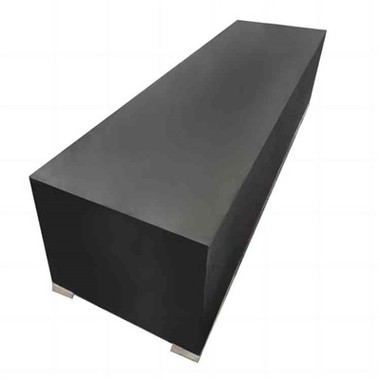
Graphite lining body:
Usually a rectangular structure, directly in contact with the high-temperature tin liquid, plays the role of isolating the glass liquid from the refractory material.

Graphite FSB:
installed at a specific position of the tin bath, used to control the flow of tin liquid and the width of the glass ribbon to ensure uniform forming of the glass ribbon.

Graphite positioning body:
cooperates with the positioning groove on the side wall of the tin bath to realize self-positioning installation of the graphite lining.
--Installation and fixing technology of graphite lining
There are several structures for fixing graphite lining:
Traditional fixing method: In the early stage, bottom bricks were used to press the graphite lining, but the disadvantage was that the graphite lining could not be replaced; or heat-resistant steel strips were used to press the graphite lining, but the strips were easy to deform and needed to be unsoldered when replaced.
Self-positioning graphite lining device: The latest technology uses a structure that can stabilize the graphite lining without fixing, such as the self-positioning graphite lining device for tin bath proposed by Chinese patent CN209428392U, which includes:
A group of graphite liners, each graphite liner comprises a rectangular lining body, one side of the lining body is provided with a positioning body extending outward, and the top of the positioning body is provided with a positioning boss.
The positioning groove matched with the positioning body is arranged on the side wall of the tin bath, and a group of concave positioning parts are arranged on the upper end of the positioning groove.
The positioning body of each graphite liner is installed in the positioning groove on the side wall of the tin bath, wherein the positioning protrusion on the positioning body forms a positioning match with the recessed positioning portion.
This self-positioning design makes it extremely convenient to replace the graphite lining, improves maintenance efficiency and reduces maintenance costs.
--Innovative Application of Graphite FSB
Graphite FSB are key components in the tin bath, used to control the flow and shaping of glass liquid. Traditional graphite baffles are installed during cold repair, which easily leads to bubbles at the bottom of the bath, affecting the quality of glass products. To address this problem, the latest technology is to use the method of hot installation of graphite FSB.
In addition, the newly developed graphite FSB are treated with silicon carbide coating on the surface, and the corrosion resistance of tin liquid is increased to 3 times that of traditional products, helping customers reduce downtime and maintenance costs by more than one million yuan per year. This surface functional modification technology significantly improves the service life and performance of graphite FSB.
Graphite in Float Glass Stirring System
--Importance of stirring in float glass production
In float glass production, stirring are key equipment to ensure the uniformity of glass liquid. Stirring cause the flow of glass liquid through thermal effects and physical movement, improving the temperature uniformity and chemical uniformity of glass liquid.
Mechanical stirring is mainly used in glass furnaces for producing float glass and optical glass, because these glasses have extremely high uniformity requirements. In the melting zone of the melting furnace, stirring are rarely used because the convection current is strong enough and the temperature is very high; in the cooling zone and forehearth of the melting furnace, stirring play an important role.
--Design and Application of Graphite Stirring
Graphite materials are widely used in the manufacture of stirring in float glass production due to their excellent high temperature performance and chemical stability. The design of graphite stirring usually considers the following factors:
- Agitator shape: According to the stirring requirements, the graphite agitator can be designed into various shapes such as propeller type, anchor type, turbine type, etc.
- Agitator size: The size of the agitator needs to match the size of the furnace or forehearth to ensure the best stirring effect.
- Stirring speed: Different stirring speeds will produce different shear forces and flow patterns, affecting the uniformity of the glass liquid.
Studies have shown that there is a linear relationship between the insertion depth and rotation speed of the stirrer, and the optimal rotation speed decreases as the insertion depth of the stirrer increases. The rotation effect of the stirrer can bring the backward-flowing glass liquid upward into the forward flow at high rotation speeds, improving the overall flow pattern of the glass liquid.
--Mixing Process Optimization
In order to improve the efficiency and life of graphite stirring, researchers have conducted a lot of process optimization research:
- Stirring speed optimization: Studies have shown that stirrer speed has a significant effect on the mechanical properties of composites. For example, in stir casting of aluminum-graphite composites, increasing the stirring speed from 200rpm to 800rpm increased the material's hardness, compressive strength, and wear resistance.
- Stirring time control: Appropriate stirring time can ensure uniform distribution of the glass liquid while avoiding energy waste and equipment wear caused by excessive stirring.
- Improved stirring method: In addition to traditional mechanical stirring, auxiliary technologies such as ultrasonic treatment can be combined to improve the dispersion effect in the glass liquid.
Graphite in Float Glass Forming and Conveying System
--Application of graphite in glass forming process
In the process of float glass forming, graphite materials are mainly used in the following aspects:
- Graphite positioning device: used to fix and position the glass ribbon to ensure the position accuracy of the glass ribbon during the molding process.
- Graphite scraper: used to remove excess droplets on the glass surface or adjust the edge shape of the glass ribbon.

--Application of graphite in glass conveying system
In float glass production lines, graphite materials are also widely used in glass conveying systems:
Graphite transition roller: a key component for smoothly transitioning high-temperature glass from the tin bath to the annealing furnace. For example, a graphite transition roller manufacturing technology uses high-purity flake graphite rollers. Since the thermal conductivity of high-purity flake graphite decreases with increasing temperature, and even at extremely high temperatures, high-purity flake graphite becomes an insulator, when the high-temperature glass enters the transition roller table from the tin bath, the lower surface of the glass will not be overcooled.
Graphite support structure: used to support and guide the glass ribbon to ensure the stability of the glass ribbon during transportation.
Graphite guide device: used to guide the movement direction of the glass ribbon to ensure that the glass ribbon is transported along the predetermined path.
The application of these graphite components significantly improves the efficiency and product quality of float glass production lines and reduces glass defects caused by temperature changes or mechanical friction.
At Last
With over 25 years of experience in graphite materials and production support, SHJ-CARBON continues to provide solutions tailored to the demanding conditions of the glass industry. In upcoming articles, we'll further explore graphite applications across forming, conveying, and maintenance in float glass manufacturing. If your process involves graphite components, our engineering team is ready to offer professional consultation and product recommendations based on your specific requirements.
- Graphite in the production of float glass and thick glass
- Graphite in the production of float glass CVD coated glass
- Graphite in cold repair of float glass
- Special Application of Graphite in Float Glass
- Please pay attention to the subsequent articles for discussion of this part!