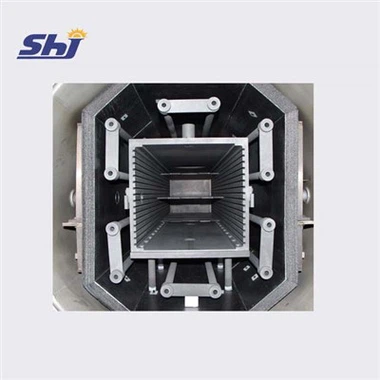
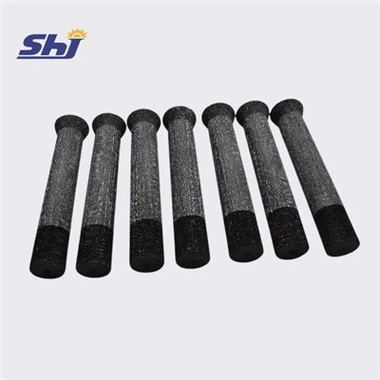
Graphite Heating Elements: Selection, Materials, and Applications for High-Temperature Furnaces
Feb 11, 2026
Why Graphite Materials Are Essential for High-Temperature Furnaces?
As a project engineer at SHJ CARBON, I have encountered numerous projects over the past 18 years, and one thing has become clear: whenever a furnace operates at temperatures above 1500°C, carbon-based materials are indispensable. This is not a coincidence, but rather a result of the inherent properties of the materials themselves.
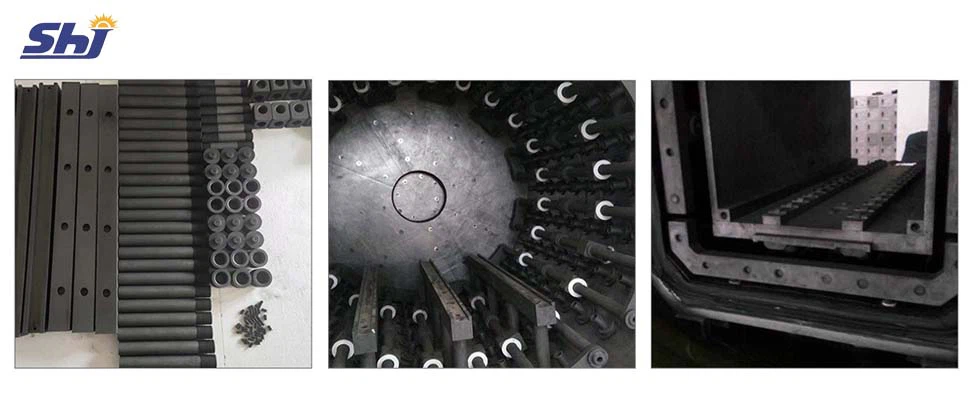
Carbon materials are primarily used in the high-temperature sections of industrial furnaces, such as vacuum heat treatment furnaces, high-purity processing furnaces, single-crystal silicon pulling furnaces, and graphitization furnaces, which operate at temperatures above 1500°C. These materials are classified based on their application, including heating elements, thermal insulation materials, furnace body structural components, and transport fixture materials. To make this clearer, here's a simple analogy:
- Heating Element: The heart that generates heat
- Insulating Material: The outer layer that retains heat
- Structural Material: The skeleton that supports the entire system
- Transport Fixture: The tools used to move materials at high temperatures
Under the protection of inert gases, carbon materials can be used stably at temperatures above 1500°C. They are not only cost-effective and readily available but also the only superior material for such applications. Depending on their intended use, carbon materials are flexibly employed while considering their machinability, high-temperature characteristics, and shaping techniques, all while maintaining a controlled furnace atmosphere.
In heating elements, the main materials used are graphite particles or processed graphite products. In structural materials or transport fixtures, graphite products or C/C composite materials are used. Artificial graphite or C/C composites serve as heating elements, furnace structures, or transport fixtures, and the properties of these materials often dictate the performance of the components.
The key properties of these materials are typically related to electrical resistivity, strength, and sometimes even bulk density, thermal conductivity, and thermal expansion coefficient. In semiconductor fields, such as single-crystal silicon pulling furnaces and optical fiber production furnaces, high-purity products with low impurity concentrations are required to prevent contamination.
Heating Element Selection: Metal or Non-Metal?
High-temperature industrial furnaces use heating elements that can be categorized into two main types: metallic and non-metallic. Metal heating elements include Fe-Cr-Al alloys, Ni-Cr alloys, tungsten, molybdenum, etc., while non-metallic heating elements include silicon carbide, molybdenum carbide, nickel-chromium, and carbon-based materials. Among these, graphite heating elements, when protected by inert gases, can reach a maximum operating temperature of approximately 3000°C, and are widely used in both vacuum and non-vacuum furnaces. Carbon-based heating elements are divided into graphite and carbon materials, with graphite being the primary choice in most cases.
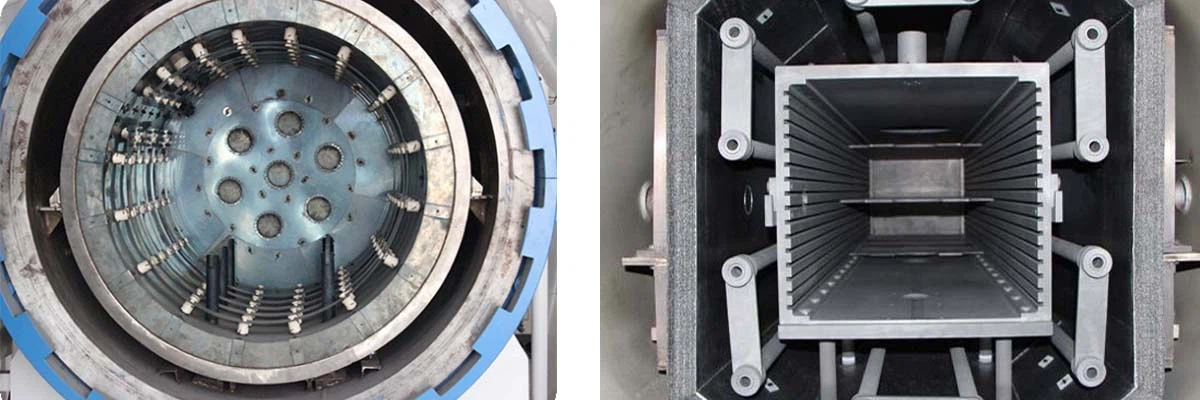
Carbon materials that have been roasted at around 1000°C have 3-4 times higher resistivity than graphite, so they are only used when high-resistance materials are needed. However, if the operating temperature exceeds the heat treatment temperature, the size of carbon-based materials will change, and their resistivity will decrease, leading to material degradation. Therefore, careful attention must be paid to usage conditions.
Material Comparison Table:
|
Material Type |
Material |
Max Operating Temperature |
Characteristics |
|
Metal |
Fe-Cr-Al Alloy |
1200°C |
Cheap but limited temperature range |
|
Ni-Cr Alloy |
1150°C |
Can withstand high temperatures, suitable for high-temperature environments |
|
|
Molybdenum & Tungsten |
1800-2000°C |
Requires oxygen exclusion, suitable for extreme high-temperature conditions |
|
|
Non-Metal |
Silicon Carbide |
1650°C |
Excellent high-temperature resistance but lower upper limit |
|
Molybdenum Disilicide |
1800°C |
Can withstand high temperatures, but brittle and prone to fracture |
|
|
Graphite |
3000°C |
Can withstand extremely high temperatures in a protective atmosphere, suitable for specialized applications |
What Are the Advantages of Graphite?
The following table illustrates the characteristics of graphite heating elements. Due to graphite's low resistivity, it is commonly used in low-voltage, high-current applications. Additionally, graphite has a small thermal expansion coefficient, which gives it strong resistance to thermal shock in rapid heating and cooling conditions. However, unlike metal heating elements, graphite is not as flexible and is more brittle when subjected to mechanical shock, so care should be taken during use.

Due to differences in raw materials and manufacturing processes, the electrical resistivity of artificial graphite varies in relation to temperature. Generally, the resistivity decreases from room temperature to about 500-600°C, after which it either increases linearly with temperature or continues to decrease. Therefore, it is important to consider how the resistivity of the material changes within the heating element's operational temperature range.
The chart below illustrates the resistivity changes with temperature for graphite, silicon carbide, and nickel-chromium heating elements.

The bending strength of graphite increases as the temperature rises from room temperature to 2500°C, reaching about twice its value at room temperature. However, after exceeding 2500°C, the bending strength rapidly decreases. Similarly, both tensile strength and compressive strength follow a similar pattern.

The chart below illustrates the change in bending strength relative to temperature for graphite heating elements.
Graphite heating elements can be used at temperatures around 3000°C under the protection of inert gases. This is due to graphite's ability to resist melting under normal atmospheric pressure, with a sublimation temperature of about 3500°C, which is very high. Additionally, the vapor pressure at 2200°C is as low as 10⁻⁶ atm. However, in air, graphite starts to oxidize around 400°C, in water vapor at around 700°C, and in carbon dioxide gas around 900°C, rendering it unsuitable for use under these conditions.
Maximum Operating Temperatures for Various Non-Metallic Heating Elements in Different Atmospheres (°C)
|
Atmosphere |
SiC Series |
MoSi₂ Series |
LaCrO₂ Series |
Graphite Series |
|
In Air |
1650 |
1800 |
1800 (with ≥10% O₂) |
400 |
|
H₂ (Dry) |
1400 |
1350 |
Not Suitable |
2500 |
|
N₂ |
1450 |
1600 |
Not Suitable |
3000 |
|
Ammonia (NH₃) |
1300 |
1400 |
Not Suitable |
2500 |
|
Carbon Dioxide |
1600 |
1600 |
900 |
|
|
Sulfur Dioxide |
1300 |
1600 |
||
|
In Vacuum |
1100 |
1300 |
Not Suitable |
2200 |
Maximum Operating Temperatures for Various Metallic Heating Elements in Different Atmospheres (°C)
|
Atmosphere |
Fe-Cr Alloy |
Ni-Cr Alloy |
Molybdenum |
Tungsten |
|
In Air |
1200 |
1150 |
Not Suitable |
Not Suitable |
|
H₂ |
1200 |
1150 |
1800 |
2000 |
|
N₂ |
1000 |
1150 |
1600 |
1800 |
|
Ammonia (NH₃) |
Not Suitable |
1000 |
1800 |
2000 |
|
In Vacuum |
1200 |
1000 |
1800 |
2000 |
Graphite Heating Elements in Gas Atmospheres
The choice between metal and non-metal materials for heating elements largely depends on the process requirements, which in turn determine the design of the heat field and overall equipment configuration. Cost considerations also play a key role, especially for customized needs, which are a result of a balance between various factors.
Considerations for Choosing Heating Elements
|
Factor |
Metal Heating Elements |
Other Non-Metallic Materials |
Graphite Heating Elements |
|
Temperature Limit |
1200-2000°C |
1100-1800°C |
2200-3000°C |
|
Atmospheric Requirements |
Many restrictions |
Relatively flexible |
Must prevent oxidation |
|
Initial Investment |
Medium |
Higher |
Medium to high |
|
Long-Term Maintenance |
Low |
Medium |
Low |
|
Suitable Applications |
Standard heat treatment |
Specialized processes |
Extreme high temperatures |
The Shape of Heating Elements
Although the representative shapes of graphite heating elements are tubular, rod-shaped, plate-shaped, and granular, graphite materials are easy to machine, allowing them to be made into various shapes to meet different usage requirements.
Graphite heating elements come in tube, rod, plate, and custom designs. They are widely used in heat treatment furnaces for metal quenching, tempering, annealing, powder metallurgy, ceramics, sintering furnaces, single-crystal silicon pulling furnaces, and more.

Tubular Heating Elements:
- Suitable for tube furnaces
- Even heating, easy installation

Rod-Shaped Heating Elements:
- Ideal for localized high heating
- Flexible design, high heat flux density

Plate-Shaped Heating Elements:
- Suitable for planar heating
- Can also be used as heat shields

Custom Shapes:
- Solutions for special furnace designs
- Fully tailored to process requirements
Real-World Applications
In the projects I have worked on, graphite heating elements are mainly used in:
- Heat Treatment Industry: Quenching, tempering, annealing
- Powder Metallurgy: Metal and ceramic sintering
- Semiconductors: Single-crystal silicon growth
- Scientific Research: Ultra-high-temperature experiments
- Aerospace: Special material processing
System Thinking: The Heating Element Is Not an Isolated Component
The heat field in a furnace is a systematic engineering project. Graphite heating elements are part of the high-temperature industrial furnace's heat field system, and they must work in coordination with other materials, such as insulating materials and C/C composite materials, to function effectively. As a core component of high-temperature industrial furnaces, the materials used in the heat field play a crucial role.
The significance of the various indices of graphite heating elements is closely related to the manufacturing process of graphite materials. For more details, please refer to the article "How Important Is the Microscopic Structure of Artificial Graphite? How Does It Affect Performance Indices?"
Achieving Optimal Performance with Graphite Heating Elements
To achieve the best performance from graphite heating elements, they must be used in combination with other materials:
Insulation System:
Use graphite felt, carbon fiber insulation
Reduce heat loss
Support System:
C/C composites or high-strength graphite
Maintain structural stability
Atmosphere Control:
Maintain the purity of the protective atmosphere
Design an effective airflow path
My Selection Advice
Clarify Process Requirements:
- What temperature needs to be reached?
- How fast should the temperature rise?
- What are the temperature uniformity requirements?
- What is the working atmosphere?
01
Match Material Properties:
- Ensure the resistivity matches the power supply
- Strength should meet structural requirements
- Purity should meet process standards
02
Design the Shape:
- Consider furnace space
- Plan the heat field distribution
- Leave maintenance access paths
03
Calculate the Economic Costs:
- What is the initial investment?
- How long will it last?
- What are the maintenance costs?
04
Consider Future Technological Developments
What will future advancements in technology bring?
Technological Developments: What Does the Future Hold?
From my observations over the years, there are several development directions for graphite heating element technology:
Material Advancements:
Higher purity graphite
Better performance C/C composites
New coating technologies
Design Optimizations:
Modular design for easier replacement
Integrated temperature monitoring
Smart control systems
Application Expansion:
New energy material preparation
Superconductivity research
Space environment simulation
Final Thoughts
Ultimately, selecting graphite heating elements is about answering one question: What does your process truly require?
Are you aiming for extreme temperatures? Or is temperature uniformity more important? Or perhaps you need rapid temperature changes? By clearly defining the core requirements, you can select the most suitable material.
I often tell customers that selecting graphite heating elements is like choosing glasses – the most expensive isn't necessarily the best, but the most suitable is. In some situations, regular graphite is enough, while in others, high-purity materials are a must. Striking this balance requires experience.
After 18 years in the industry, I've witnessed many technological advancements in carbon-based materials. But one thing remains constant: understanding material properties and respecting process requirements is key to making the best choice.
If you're interested in how the microscopic structure of graphite materials affects performance, we can talk about that next time. After all, understanding the microscopic structure is key to mastering the macroscopic performance.
Recommended related articles
-
Vacuum Furnace: How It Works, Types and Key Applications
-
Case Study: Replacing Thermal Insulation in MIM Vacuum Furnace
-
MIM Furnace Heat Zone Optimization: Practical Case Share
-
How Do I Know If My Vacuum Furnace Insulation Needs Replacement?