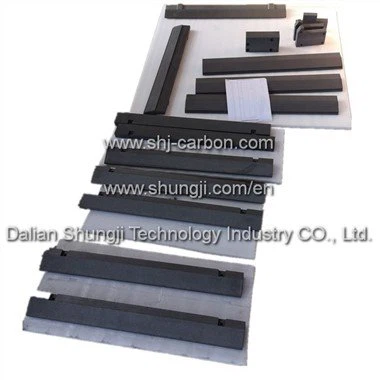
Structure and Principle of Single-Inlet and Exhaust Graphite Reactor (Coater, for Float Glass Coating)
Apr 22, 2026
Why Reactor Design Matters in Float Glass Online Coating
In float glass online coating, product quality depends on much more than the coating chemistry itself. For manufacturers aiming to produce stable and high-performance coated glass, reactor design plays a direct role in gas distribution, coating uniformity, thermal stability, exhaust efficiency, and contamination control.
A poorly matched reactor structure can lead to uneven film thickness, unstable coating performance, gas leakage, backflow issues, and unnecessary maintenance downtime. For this reason, more float glass producers are paying closer attention to the design and material selection of graphite reactors used in online CVD coating systems.
Among the available reactor structures, the single-inlet single-exhaust graphite reactor remains one of the most practical options for continuous float glass production. Its clear gas flow path, stable operating logic, and compatibility with large-scale online coating lines make it a preferred choice for many functional thin-film applications.

Common Challenges in Float Glass Coating Lines
For float glass manufacturers, several coating problems often come back to one core issue: whether the reactor can provide a stable and controllable reaction environment.
Common production concerns may include:
uneven coating thickness across the glass width,
unstable gas residence time above the glass surface,
backflow of exhaust gas into the reaction area,
premature wear of graphite parts under high-temperature conditions,
and contamination risks that affect optical or functional film performance.
When these issues appear, the root cause is often not just the gas formula or process settings. In many cases, it is the reactor structure itself that limits coating stability.
What This Article Will Help You Understand
This article explains the structure and working principle of a single-inlet single-exhaust graphite reactor used for float glass online coating. It covers how the gas flows through the reactor, why the U-shaped channel design matters, how the graphite body is divided into functional zones, and why high-purity graphite is widely used in this application.
If you are evaluating graphite reactor components, planning a new coating line, or trying to improve coating stability on an existing float glass production line, understanding the reactor structure is an important first step.
Positioning and functionality
-
Single inlet and exhaust
Core scenario: Online coating station on a float glass production line, where the glass travels continuously in the "Glass travel" direction (right arrow at the bottom of the figure), and the reactor is fixed above the glass to complete continuous coating.
-
Exhaust to abatement system
Final exhaust gas destination: Exhaust to abatement system (exhaust gas is discharged into the waste gas treatment system), where process waste gas (including silane, hydrogen, etc.) is treated to render it harmless before being discharged.

Complete airflow path (marked with orange arrows, core working logic)
Intake phase (vertically downward)
Process gas is injected vertically downwards (↓) from the top air inlet chamber, and then transported downwards through the air inlet and the vertical channel inside the graphite component to the surface above the glass ribbon.
The raw feed gas first passes through the inlet buffer chamber to stabilize the gas pressure, ensure uniform and pulse-free airflow, and avoid fluctuations in coating thickness.
Reaction phase (horizontal flow along the glass surface)
After the gas flows out from the bottom of the vertical channel, it flows horizontally along the **direction of travel of the glass ribbon (→)**, covering the top surface of the continuously moving glass.
In a high-temperature environment, the process gases undergo a chemical reaction, depositing a uniform functional thin film (such as a Si-C-O base film, anti-reflection film, etc.) on the top surface of the glass. This is the core reaction zone.
The horizontal line at the bottom represents a continuously moving glass ribbon. The graphite reactor maintains a very small gap (usually a few millimeters) between itself and the top surface of the glass to ensure that the gas can stay and react fully on the glass surface.
Exhaust phase (vertically upward)
The exhaust gas after the reaction flows upward (↑) through the vertical channel inside the graphite component on the right, and is finally discharged from the exhaust port and enters the exhaust gas treatment system.
The vertical channel features an exhaust flow guide structure, an exhaust chamber graphite component, and a sealing/insulation structure to ensure unidirectional flow of exhaust gas, preventing backflow and leakage.
Key structural partitions and functions
| Structural regions | Function Description |
| Intake system | It includes an air inlet chamber, a buffer pressure stabilizing chamber, and an air inlet, to achieve uniform and stable injection of process gas and avoid uneven film thickness caused by direct impact on the glass surface. |
| Graphite body (flow guide/reaction zone) | Made of high-purity graphite, it is divided into an air intake guide section, a horizontal reaction section, and an exhaust guide section, forming a complete U-shaped airflow channel. It is resistant to high temperatures and corrosion, and avoids metal contamination of the glass film layer. |
| Sealed/insulated structure | Separate the air inlet chamber, reaction chamber, and exhaust chamber to prevent gas crossflow; isolate the reactor heat to maintain a stable temperature in the reaction zone; and seal the gap between the reactor and the glass to prevent gas leakage. |
| Exhaust system | It consists of an exhaust guide structure and an exhaust port, which efficiently removes the exhaust gas after the reaction, ensuring stable pressure inside the reactor and preventing the exhaust gas from backflowing and contaminating the glass film. |
| Glass load-bearing area | The continuously moving float glass ribbon serves as the carrier for thin film deposition. It moves at a constant speed along the "Glass travel" direction, enabling continuous, high-volume film deposition production. |
Design Highlights and Technical Principles
| Items | Float glass online coating reactor |
| Application scenarios | Float glass production line, continuous, high-volume online coating |
| Structural features | Single inlet and exhaust, U-shaped horizontal flow channel, suitable for continuous glass movement |
| Core Objectives | Ensure uniform film thickness across the entire width and length of the glass ribbon for continuous and stable production. |
| Graphite size | Typically around 4 meters (to match the width of the glass production line), large sizes are customizable. |
Advantages of single-inlet and exhaust structure: simple structure, clear airflow path, and easy maintenance; single inlet ensures gas uniformity, and single exhaust ensures stable pressure, making it suitable for continuous production.
U-shaped flow channel design: vertical air intake → horizontal reaction → vertical exhaust, avoiding direct airflow impact on the glass surface, extending the residence time of gas on the glass surface, and improving thin film deposition efficiency and uniformity.
Graphite material compatibility: High-purity isostatic graphite (or a substitute for high-purity molded graphite), high temperature resistant (600~700℃, glass coating temperature), corrosion resistant, no metal contamination, ensuring the purity and performance of the glass coating.
Continuous production adaptation: The reactor is fixed while the glass moves continuously, enabling automated, large-scale coating. This is the core equipment structure for online coating of float glass.
Supplementary Explanation
In actual production, the flow channel size and air inlet/exhaust port position will be adjusted according to the glass width and coating process.
This structure is a classic structure for online CVD coating of float glass and is widely used in the production of functional thin films such as glass antireflective coatings, Low-E films, and Si-C-O protective films.
An exhaust gas treatment system is an essential component used to treat flammable, explosive, or toxic waste gases such as silanes and hydrogen, ensuring production safety and compliance with environmental standards.
Graphite main structure (core carrier of reactor)
Graphite is an ideal material for high-temperature CVD processes, possessing characteristics such as high temperature resistance, good chemical stability, and ease of processing. It is divided into three functional regions:
Upstream graphite: Located directly below the inlet chamber, on the left side.
Function: Guides the process gas in the inlet chamber downwards, while simultaneously forming an airflow buffer to prevent direct impact on glass ribbon and ensure uniform gas distribution.
Midstream graphite: Located to the right of upstream graphite, it is the core reaction zone.
Function: It supports the substrate to be coated (the horizontal line at the bottom of the diagram represents the substrate/stage), and simultaneously forms a U-shaped gas flow channel, allowing the process gas to remain sufficiently on the top surface of glass ribbon and undergo chemical reactions to complete the deposition of the Si-C-O thin film. The arrow pointing to the right at the bottom (→) indicates that the gas flows horizontally along the glass surface, achieving large-area uniform coating.
Downstream graphite: Located to the right of the midstream graphite, below the exhaust chamber.
Function: Guides the reacted exhaust gas upwards into the exhaust chamber for discharge, while preventing backflow and ensuring stable unidirectional airflow.

Core process parameter benchmark (Si-C-O base film deposition)
| Zone | Temperature range | Key Explanation |
| Overall reactor temperature | 1000℃ - 1300℃ | Si-C-O thin films typically require high-temperature pyrolysis of the precursor. If the temperature is below 900℃, a soft film with excessive hydrogen content is easily formed; if the temperature exceeds 1350℃, it may cause the graphite matrix to volatilize or the film to crystallize. |
| Temperature difference control | ±2℃ | Temperature uniformity within the reactor is a prerequisite for ensuring uniform film thickness, and this needs to be monitored in real time using an infrared thermometer. |
| Heating/cooling rate | 5℃ - 10℃/min | A stepped heating method (such as preheating and pyrolysis at 800℃ first, and then heating to 1200℃ for deposition) is used to reduce the impact of thermal stress on the film adhesion. |
• Gas source composition and typical flow rate:
a) Carrier gas: High-purity argon (Ar) or hydrogen (H₂).
Flow rate: 500 - 2000 sccm (standard mL/min). Its main function is to transport the precursor and dilute its concentration, preventing gas-phase nucleation and particle formation.
b) Silicon source (Si): Commonly used are silanes (SiH₄), hexamethyldisiloxane (HMDSO), or methyltriethoxysilane (MTES).
Flow rate: 10 - 100 sccm.
c) Carbon source (C): Commonly used are methane (CH₄) and propane (C₃H₈).
Flow rate: 5 - 50 sccm.
d) Oxygen source (O): Usually introduced by oxygen (O₂) or by the precursor itself (such as a silicon oxide source).
Flow rate: 0 - 50 sccm (mixed as needed, adjusting the Si/C/O atomic ratio).
• Key points of gas path design:
Inlet flow rate: Laminar flow must be maintained to avoid turbulence causing streaks on the film surface.
Si/C/O atomic ratio: Typically controlled between 1:1:1 and 1:2:1 to form a stable Si-O-C network structure.
• Pressure and environment (determine packing density and growth rate)
| Parameter | Recommended range | Technical Specifications |
| Chamber pressure | 50 Pa - 500 Pa (Low pressure CVD) | A low-pressure environment helps prolong gas residence time and improve film density. If the pressure is too high (>1 kPa), pinholes are likely to appear in the film; if it is too low, the growth rate will be too slow. |
| Vacuum degree | < 5 × 10⁻³ Pa | Before deposition, a complete vacuum must be drawn to remove air (water vapor/oxygen) and prevent film oxidation and contamination. |
| Duration of stay | 5 - 20 seconds | The residence time of gas in the midstream graphite reaction zone directly affects the deposition thickness. |
In summary, the graphite reactor (coater) for float glass coating is like a small chemical plant (or chemical unit), operating independently inside the tin bath, but closely related to the tin bath process parameters and the glass ribbon. Furthermore, coating quality is the most critical issue, as raw materials, equipment, process parameters, tin bath condition, and operation all affect the final product quality.
Why More Float Glass Manufacturers Are Choosing Custom Graphite Reactor Solutions
In real production, a graphite reactor is not just a machined component installed above the glass ribbon. It is a process-critical part that directly affects coating consistency, gas flow behaviour, operating stability, and long-term equipment reliability.
For float glass manufacturers, choosing the right graphite reactor means choosing a structure that matches the actual line conditions. This includes glass width, coating type, temperature range, gas system, expected service life, and maintenance requirements. A well-designed reactor can help improve coating uniformity, reduce operating risk, and support more stable continuous production.
That is why customisation matters. Standard graphite parts may not always meet the needs of different float glass coating lines, especially when the process requires specific flow-channel geometry, large-size machining, tighter dimensional control, or better resistance to aggressive coating environments.
What to Prepare Before Sending an Enquiry
If you are looking for a graphite reactor or graphite reactor components for float glass online coating, it is helpful to prepare a few key details before discussion:
- glass width,
- coating type or target film system,
- working temperature range,
- gas composition,
- reactor size or drawing,
and any current production problems such as uneven coating, short service life, or flow instability.
With these details, the technical discussion becomes much more efficient, and the graphite solution can be matched more accurately to your process.
Talk to SHJ CARBON About Your Float Glass Coating Project
At SHJ CARBON, we focus on supplying high-purity graphite solutions for demanding industrial applications. For float glass online coating, we can support customers with graphite material selection, custom machining, reactor structure optimisation, and application-based technical communication.
If your team is developing a new online coating system or looking to improve the performance of an existing float glass coating line, we welcome your enquiry.
You are welcome to send us your drawing, dimensions, coating application, or current operating challenge. Our team will be glad to discuss a suitable graphite solution for your project.
A more stable coating process starts with a more suitable reactor structure. If you are working on float glass online coating, choosing the right graphite reactor is one of the most important steps toward better film quality and more reliable production.