How to Select Suitable Graphite for Float Glass CVD Coating Machines
Jul 17, 2025
Introduction
In float glass production, the CVD (Chemical Vapor Deposition) process is essential for applying specialized coatings to glass surfaces, improving their energy efficiency and durability. For this process to be effective, the equipment involved, particularly the CVD machine, needs materials that can endure extreme temperatures and chemical reactions. Graphite plays a crucial role here, as it provides the necessary heat resistance and stability within the CVD chamber, ensuring smooth operation.
With extensive experience in the float glass industry, SHJ CARBON understands the critical role graphite plays in optimizing the performance of CVD machines. In this article, we'll guide you through how to choose the right type of graphite for your CVD system, focusing on its key properties like thermal stability and corrosion resistance. Our insights will help you improve production efficiency and reduce downtime, making it easier to select the best materials for your needs.

Key Factors in Selecting Graphite for Float Glass CVD Coating Machines
Selecting suitable graphite for float glass CVD coating machines requires comprehensive consideration from multiple dimensions such as material performance, structural design, and process compatibility, in combination with the high-temperature environment of float glass production lines, CVD reaction characteristics (e.g., gas distribution, film uniformity), and the core functions of graphite (support, flow guiding, corrosion resistance, etc.). The specific points are as follows:
Ⅰ. Core Material Performance Indicators
The material of graphite directly determines its stability in high-temperature CVD environments and its impact on coating quality. The following indicators should be focused on:
1. Purity (Carbon Content)
- Requirement: High-purity graphite is preferred, with a carbon content of ≥99.9%, or even 99.99% or higher.
- Reason: During the CVD coating process, if graphite contains impurities (such as metals, oxides), they may volatilize or participate in reactions at high temperatures, leading to defects like spots and color differences in the glass film (e.g., iron impurities may form colored pollutants when coating SiO₂ films). High-purity graphite can minimize impurity interference.
2. Density and Porosity
- Requirement: High density (≥1.7 g/cm³) and low porosity (≤15%).
- Reason: High-density graphite has a dense structure, which can reduce the penetration of reaction gases (such as SiCl₄, NH₃) into the interior of graphite, avoiding "internal deposition" caused by premature gas reactions in pores, which may lead to cracking of graphite plates or slag falling to contaminate the glass surface; Low porosity can reduce the contact area between graphite and corrosive gases (such as HCl, a by-product of CVD reactions), slow down the erosion rate, and extend service life.

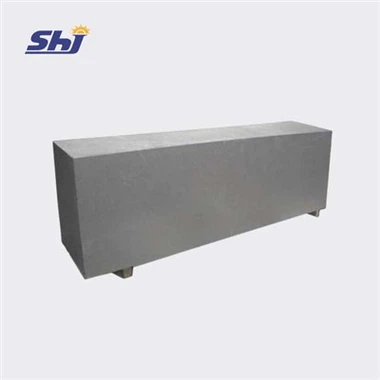
| ltem | Bulk Density | Flexural Strength (Mpa) |
Compression Strength (MPa) | Grain size(mm) |
| Materials | 1.7 | 14.5 | 32 | 2 |
SHJ CARBON has extensive experience in recommending graphite and carbon-based material solutions, offering customized plans tailored to specific operational conditions. Our expertise ensures that every solution is optimized for your unique requirements, delivering maximum performance and efficiency. Contact us today to discuss your custom solution and achieve the best results for your application.
3. Thermal Shock Resistance
- Requirement: Low thermal expansion coefficient (≤2.5×10⁻⁶ /℃), with no obvious cracking risk in the range from room temperature to 1000℃.
- Reason: In float glass production lines, graphite needs to be in a high-temperature environment of 600-1200℃ for a long time, and may experience local temperature fluctuations due to glass ribbon movement and gas injection. Graphite plates with poor thermal shock resistance are prone to fracture due to thermal stress, causing production line shutdowns.
4. Oxidation Resistance
- Requirement: Priority is given to graphite with surface treatment (such as silicon carbide SiC coating) or isostatic graphite with excellent oxidation resistance.
- Reason: At high temperatures (especially in the presence of oxygen), graphite is easily oxidized to form CO/CO₂, resulting in surface peeling and dimensional deformation. The SiC coating can form a dense protective layer, increasing the oxidation resistance life of the graphite plate by 3-5 times, which is particularly suitable for processes that require the introduction of oxygen-containing reaction gases (such as O₂ participating in SiO₂ coating).
Ⅱ. Structure and Precision Design
1. Flatness and Dimensional Accuracy
- Requirement: Surface flatness error ≤0.1mm/m, thickness tolerance ≤±0.05mm, parallelism deviation with the glass ribbon ≤0.5mm.
- Reason: Graphite is usually used as the "lower plate" or gas flow guide plate for coating reactions, and the distance from the glass ribbon surface must be strictly uniform (generally 5-20mm). If the flatness is poor, too small a local spacing will cause excessive gas flow rate and excessive deposition; too large a spacing will result in too thin deposition, eventually leading to uneven film thickness and color difference.
2. Surface Finish
- Requirement: Surface roughness Ra ≤1.6μm, with no obvious scratches or burrs.
- Reason: A rough surface will cause turbulence of reaction gases, destroying the laminar flow state of the gas flow (CVD coating requires stable laminar flow to ensure uniform deposition); at the same time, local high temperatures at burrs or protrusions may trigger premature gas reactions, forming granular impurities attached to the glass surface.
3. Adaptability of Gas Flow Channels
- Requirement: Customize grooves, openings, or flow guide structures of graphite according to the gas injection method of the coating machine (such as slit type, porous type).
- Example: If an S-shaped air intake channel design is adopted, the channel size (width, depth, curvature) of graphite needs to match the gas flow rate to ensure that the gas is fully mixed and the flow rate is uniform before reaching the glass surface, avoiding local concentration.
Ⅲ . Process Compatibility
Different float glass CVD processes (such as the type of film to be coated, production line speed, temperature) have different requirements for graphite, which need to be selected targetedly:
1. Film Type
- Coating oxide films (such as SiO₂, TiO₂): Reactions often involve oxidizing gases (O₂), so graphite with stronger oxidation resistance (such as surface-coated SiC) should be selected to avoid oxidation and peeling of graphite;
- Coating nitride films (such as Si₃N₄): The reaction gas contains alkaline gases such as NH₃, so graphite needs to be resistant to alkaline erosion, and high-density graphite is more applicable;
- Coating conductive films (such as ITO): Sensitive to impurities (especially metal ions), requiring ultra-high purity (99.99% or more) graphite to avoid impurities affecting the conductivity of the film.
2. Production Line Speed and Temperature
- High-speed production lines (e.g., daily melting capacity ≥600 tons): Graphite needs to withstand higher continuous thermal loads, and priority is given to isostatic graphite with high strength (flexural strength ≥20MPa) and good creep resistance (rather than extruded graphite, which has obvious anisotropy and is prone to deformation at high temperatures);
- High-temperature processes (e.g., coating zone temperature ≥1000℃): Graphite with low thermal weight loss rate (oxidation weight loss ≤0.5%/h at high temperatures) is required, which can be further optimized by SiC coating or impregnated antioxidants (such as resin).
IV. Service Life and Economy
On the premise of meeting performance requirements, it is necessary to balance service life and cost:
1. Erosion Resistance and Wear Resistance
- Select graphite with a high graphitization degree (≥95%), which has a more complete crystal structure and stronger resistance to chemical erosion and mechanical wear (e.g., slight friction with the glass ribbon is not easy to produce slag);
- For parts susceptible to erosion (such as near the gas outlet), a design of local thickening or inlaying high-density graphite blocks can be adopted to extend the overall service life.
2. Processing and Maintenance Costs
- Priority is given to graphite that is easy to precision process (such as isostatic graphite, which has good isotropy and can be processed into complex structures) to reduce customization costs;
- Consider repairability: Some graphite plates can restore flatness by grinding the surface without overall replacement, reducing long-term costs.
V. Suppliers and Quality Verification
- Select suppliers with experience in the float glass industry: Their products have been verified by actual production lines and can provide standard or customized graphite matching specific coating machines;
- Request quality inspection reports: Including test data of key indicators such as purity (spectral analysis), density (water displacement method), thermal expansion coefficient (thermomechanical analysis);
- Trial test: Conduct small-batch trials to observe the stability of graphite in the actual process (such as whether it produces slag, dimensional change rate, and impact on film quality) before mass procurement.


refractory materials VS graphite materials
In float glass CVD coating machines, functional refractory materials (such as those used for continuous casting long nozzles) are difficult to replace graphite. The core reason is that there are essential differences in their performance requirements, functional positioning, and application environments. The following is a specific analysis from two aspects: key performance and functional adaptability:
I. Differences in Core Performance:
Refractories Cannot Meet the Special Requirements of CVD Coating Machines
The core performance of functional refractory materials (such as aluminum-carbon, zirconium-carbon refractories) is high temperature resistance (above 1500℃), erosion resistance, and thermal shock resistance, but their composition and performance characteristics are in significant conflict with the requirements of float glass CVD coating machines for graphite:
|
Performance Dimension |
Requirements of Float Glass CVD Coating Machines for Graphite |
Characteristics of Functional Refractories |
Conflicts |
|
Purity and Impurity Control |
Carbon content ≥99.9%, almost no metal oxide (Fe, Al, Zr, etc.) impurities to avoid film contamination |
Contain a large amount of oxides (Al₂O₃, ZrO₂, etc., accounting for 30%-60%), low carbon content (usually ≤30%) |
Oxide impurities (such as Al₂O₃, ZrO₂) in refractories may volatilize or react with reaction gases (such as HCl) at CVD high temperatures (600-1200℃), generating solid particles (such as AlCl₃), leading to defects such as spots and color differences in the glass film |
|
Chemical Stability |
Need to resist corrosion from CVD reaction gases (such as SiCl₄, NH₃) and by-products (such as HCl) without chemical reactions |
Oxide components (such as Al₂O₃) are easy to react with HCl to form soluble chlorides, leading to surface peeling of the material |
Peeled particles will contaminate the glass surface, and the material structure will be damaged, resulting in an extremely short service life (may be only 1/10 of that of graphite) |
|
Gas Permeability |
High density (≥1.8g/cm³), low porosity (≤15%) to avoid reaction gas penetration into graphite and prevent cracking |
High porosity (usually 20%-30%) and loose structure |
Reaction gases easily penetrate into the interior of refractories and form "internal deposition" due to premature reactions in pores, leading to material expansion and cracking, further aggravating slag pollution |
|
Surface Precision and Gas Flow Control |
Surface finish Ra ≤1.6μm, flatness error ≤0.1mm/m to ensure uniform gas flow distribution |
Rough surface (Ra usually ≥5μm), low processing precision (difficult to achieve precise flatness) |
The rough surface will destroy the laminar gas flow required for CVD, leading to uneven film thickness; insufficient flatness will cause deviations in the distance between the glass and the material, further aggravating coating unevenness |
II. Differences in Functional Positioning:
Refractories Cannot Adapt to the Core Functions of CVD Coating
In float glass CVD coating machines, the core functions of graphite are "high-temperature stable carrier + precise gas flow guidance + clean reaction environment":
-
1. Different stability requirements at high temperatures:
- Graphite has strong chemical inertness at high temperatures of 600-1200℃, and its oxidation resistance can be further improved through coatings (such as SiC) to ensure long-term stability;
- Although refractories can withstand high temperatures, in the coupled environment of "high temperature + corrosive gas" in CVD, oxide components are prone to react, and the structure is easy to collapse, unable to maintain dimensional stability for a long time (for example, aluminum-carbon materials used for long nozzles may lose more than 30% of their weight in 24 hours at 1000℃ in an HCl atmosphere).
-
2. Different requirements for "cleanliness":
- Glass coating has extremely high requirements for surface cleanliness (the number of particles above 0.1μm per square meter is allowed to be ≤10), and the high purity and low impurity characteristics of graphite are key guarantees;
- The metal oxides, silicates, and other impurities contained in refractories, as well as pollutants generated by volatilization or reaction at high temperatures, cannot meet the cleanliness requirements at all.
-
3. The irreplaceability of structural precision:
- Graphite can be precisely processed (such as isostatic graphite, whose isotropy makes it easy to process into complex gas flow channels) to meet the precise control of gas flow guidance required by CVD;
- Refractories are brittle and difficult to process, and cannot be made into high-precision flow guide structures (such as slit-type gas flow channels), directly leading to loss of control over coating uniformity.
-
4. Functional Refractories Cannot Replace Graphite
The performance (purity, chemical stability, surface precision, etc.) of functional refractory materials is completely mismatched with the core needs of float glass CVD coating machines. Replacement will lead to a serious decline in film quality (defect rate increased by more than 10 times), a surge in equipment failure rates (such as frequent shutdowns for cleaning), and a significant shortening of service life (from 3-6 months for graphite to 1-2 weeks), with negative economy and feasibility.
At present, graphite is still the best choice for float glass CVD coating machines, and no other materials (including functional refractories) can fully replace its comprehensive performance.
It should be clearly stated that all core components in direct contact with CVD reaction gases (such as SiCl₄, NH₃) and glass surfaces (such as coating graphite plates, gas flow guide plates, nozzle seats) must not be replaced with refractory materials. The reasons are as follows:
- Oxide impurities (such as Al₂O₃, ZrO₂) in refractories will contaminate the film, leading to defects such as spots and color differences;
- Their chemical stability is insufficient, and they are prone to react with reaction by-products (such as HCl), leading to material peeling and sharply reduced service life;
- Surface precision and gas permeability cannot meet the requirements of coating for uniform gas flow and cleanliness.
Conclusion:
Graphite suitable for float glass CVD coating machines must meet the four core requirements of "high purity, high density, high precision, and strong adaptability": purity ensures film cleanliness, density and thermal shock resistance ensure high-temperature stability, precision ensures coating uniformity, and process compatibility ensures continuous and efficient operation of the production line. Finally, the optimal selection must be determined through performance testing and actual verification in combination with specific coating processes (film type, temperature, speed) and cost budgets.