Graphite Density: A Complete Guide to Understanding and Measuring
Feb 24, 2026
What Is Graphite Density and Why Does It Matter?
If you're working with carbon materials, you've likely encountered the question: "What is the density of graphite?" But density is more than just a number. It serves as a critical indicator of graphite's quality and performance.
In simple terms, graphite density typically ranges from 1.5 to 2.23 g/cm³, depending on its form and production process. Understanding these values for your specific application is crucial.

Think of graphite density like bone density in humans-it reflects structural integrity, strength, and porosity. Whether you're manufacturing lithium-ion batteries, designing high-temperature furnaces, or sourcing materials for semiconductor production, understanding graphite's density is essential for achieving optimal performance.
In this guide, we'll explore everything you need to know about graphite density-from theoretical values to real-world applications, and how to measure it accurately.
Theoretical vs. Actual Graphite Density: Why the Difference Matters
In an ideal world, where graphite crystals are flawless and free from impurities, the theoretical density of graphite is 2.266 g/cm³. This value is derived from X-ray diffraction analysis of perfect graphite crystals, where carbon atoms are arranged in a hexagonal honeycomb structure.
However, real-world graphite rarely matches this perfect scenario. Why does the actual density fall short?
- Porosity: Natural graphite contains microscopic pores, which reduce its density.
- Crystal imperfections: Manufacturing processes can't achieve perfect crystal alignment, impacting density.
- Impurities: Binders and other additives can alter density by introducing additional materials.
It's important to distinguish between true density (which measures only the solid material) and bulk density (which includes air pockets or voids). For most industrial applications, bulk density is the relevant measure, as it reflects how the material behaves in real-world conditions.
How Graphite Density Impacts Industrial Performance
Graphite density isn't a one-size-fits-all metric. Different applications require different graphite density ranges. Here's a quick breakdown of why density matters for your specific use case:
| Application | Ideal Density Range | Why It Matters |
|---|---|---|
| Lithium-ion battery anodes | 1.6-1.8 g/cm³ | Lower density means more porosity, allowing lithium ions to move freely |
| Electric arc furnace electrodes | 1.65-1.75 g/cm³ | Balances electrical conductivity with mechanical strength under extreme heat |
| High-temperature furnace linings | ≥1.95 g/cm³ | Higher density improves erosion resistance and stability at high temperatures |
| Semiconductor manufacturing | Up to 2.2 g/cm³ | Ultra-high density ensures gas-tightness and purity in critical processes |
For example, graphite electrode materials are optimized through decades of industrial practice. Too low a density and the electrode wears out too quickly. Too high, and thermal shock resistance is compromised. The industry has found the sweet spot of 1.65-1.75 g/cm³ to balance these factors.
Factors Affecting Graphite Density
The density of graphite is influenced by multiple factors, starting with the raw material selection. Different grades of graphite, such as petroleum coke or pitch coke, have varying inherent densities due to their chemical composition and particle structure. For instance, finer particles tend to pack more efficiently, resulting in higher density after processing. Additionally, the type of binder used during manufacturing can affect the overall density by adding extra material to the mix.
The forming method also plays a crucial role. Processes like isostatic pressing involve applying uniform pressure to graphite, leading to more uniform particle packing and higher density. On the other hand, methods like molding or extrusion may result in lower density if the graphite doesn't undergo sufficient
compaction. The impregnation cycles, where the graphite is soaked in resins or other materials to fill voids, further increase the density by filling microscopic pores. Finally, heat treatment temperatures during graphitization also impact density-higher temperatures (e.g., 2500°C) promote structural rearrangements, increasing the material's density by up to 5%.
Together, these factors determine the final density, which directly influences graphite's performance, such as its strength, thermal conductivity, and electrical resistivity, depending on the application.
Comparing the Density of Different Types of Graphite
The density of natural graphite and synthetic graphite differs considerably, and within each category, there's even more variation. Let's dive into the details.
Natural Graphite Density Range
Natural graphite typically has a density between 2.09 and 2.23 g/cm³, depending on the geological formation and crystal size. Here's how different types of natural graphite compare:
- Flake graphite: Usually falls in the range of 2.10-2.15 g/cm³, making it ideal for battery applications.
- Vein graphite: Can reach higher densities due to its larger crystal size.
- Amorphous graphite: Has a lower density as it's actually microcrystalline.

For example, graphite from Shandong province, China, has an average density of about 2.15 g/cm³, influenced by the region's unique geological conditions.
Synthetic and High-Density Graphite
The density of synthetic graphite varies greatly depending on the manufacturing process. Here's a quick comparison of the density ranges for different synthetic graphite types:
| Type | Density Range (g/cm³) | Key Characteristics |
|---|---|---|
| Standard molded graphite | 1.55-1.75 | Suitable for general industrial use |
| Extruded graphite | 1.50-1.70 | Lower density, ideal for continuous casting |
| Isostatic graphite | 1.70-1.90 | Fine-grained, isotropic properties, ideal for EDM |
| High-density graphite | 1.90-2.20 | Enhanced through multiple densification cycles |
| High-purity graphite | Up to 2.20 | Semiconductor-grade with minimal impurities |
To achieve high-density graphite, manufacturers typically use processes like:
- Fine particle size selection: Smaller particles pack more efficiently.
- Vibration compaction: Helps settle particles tightly during forming.
- Resin impregnation: Fills pores with carbon-yielding materials.
- Multiple graphitization cycles: Heat treatment increases density by 3-5%.
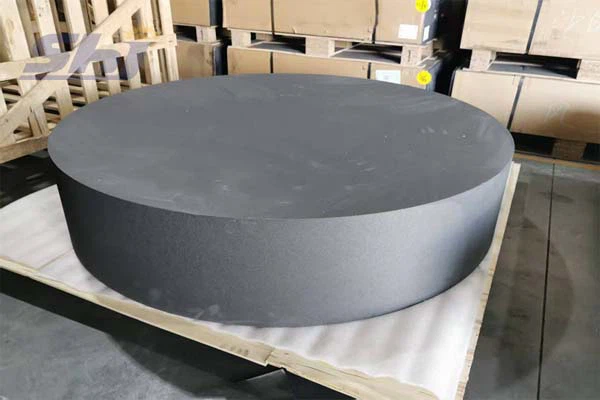
For example, graphite treated at 2500°C can have a 3-5% density increase compared to untreated material, thanks to structural rearrangements and impurity removal.
Graphite Powder Density

When we talk about graphite powder, we're referring to tap density and bulk density:
Loose bulk density: 0.4-0.6 g/cm³
Tap density: 0.7-0.9 g/cm³ (after vibration)
These values are critical for powder metallurgy and battery electrode manufacturing, where consistent filling of molds or coating substrates is essential.
Discover More About Graphite
Graphite is a fascinating material with a wide range of industrial applications, and understanding its properties is crucial for selecting the right type for your needs. This guide provides in-depth information about graphite density, its measurement techniques, and its influence on performance in various industries. However, graphite's unique characteristics don't stop at density. If you're interested in learning more about how other properties of graphite, such as hardness and thermal conductivity, play a key role in material selection, you may want to explore these related articles:

How to Test Graphite Hardness ?
Understanding hardness is essential for determining the material's wear resistance and suitability for various mechanical applications.
What Is the Thermal Conductivity of Graphite and Why It Varies?
Thermal conductivity is another critical property that affects the performance of graphite in high-temperature applications.

How to Accurately Measure the Density of Graphite
Accurate measurement of graphite density is essential for quality control and material selection. Here are the three most reliable methods for determining graphite density.
Method 1: Geometric Method for Regular Shapes
For graphite samples with a simple, regular shape (like blocks, cylinders, or disks), the geometric method is the most straightforward approach.
What you'll need:
High-precision calipers
Precision balance
Steps:
- Measure the length, width, and height (or diameter and height).
- Calculate the volume: V = length × width × height (for blocks) or V = πr²h (for cylinders).
- Weigh the sample.
- Calculate density: Density = Mass / Volume.
Method 2: Archimedes Method for Irregular Shapes
For irregular-shaped samples, use the Archimedes method (water displacement).
What you'll need:
Density determination kit
Distilled water
Steps:
- Weigh the dry sample in air.
- Immerse the sample in water and weigh again.
- Calculate density using the formula: Density = [m₁ ÷ (m₁ - m₂)] × density of water.
Method 3: X-ray Diffraction (XRD) for Theoretical Density
XRD helps calculate theoretical density based on the crystal structure of graphite.
Steps:
Measure lattice parameters using XRD.
Calculate the unit cell volume and theoretical density.
Choosing the Right Graphite Density for Your Application
When selecting graphite for your application, consider the following:
Ask These Questions:
What's your operating environment? Consider temperature, atmosphere, and mechanical stress.
What properties matter most? Strength, thermal conductivity, electrical resistivity, and purity.
What's your fabrication method? Will you machine it or use it as-formed?
What's your budget? Higher density typically requires more processing steps, which can increase cost.
Density Selection Guide
| If You Need... | Look For... | Typical Density |
|---|---|---|
| Maximum thermal conductivity | High-density, highly oriented graphite | >1.90 g/cm³ |
| Good machinability | Fine-grained isostatic graphite | 1.70-1.85 g/cm³ |
| Battery anode performance | Porous structure, good tap density | 0.8-1.0 g/cm³ |
| EDM electrodes | Fine-grained, high-strength graphite | 1.75-1.85 g/cm³ |
| Continuous casting dies | Dense, oxidation-resistant graphite | 1.70-1.80 g/cm³ |
| Semiconductor processing | Ultra-pure, gas-tight graphite | Up to 2.20 g/cm³ |
Conclusion: Understanding Graphite Density for Better Material Selection
Graphite density is a critical property that affects everything from battery performance to high-temperature applications. Understanding the right density for your specific needs ensures optimal performance, cost-efficiency, and reliability.
At SHJ CARBON, we're committed to helping you choose the right graphite material for your applications. Our experienced team offers certified density measurements, material consultation, and custom graphite solutions.
Ready to find your perfect graphite solution? Contact our carbon material experts today for:
- Free material consultation
- Density testing assistance
- Custom graphite solutions
- Sample requests for testing
Frequently Asked Questions (FAQs)
What is the density of graphite in g/cm³?
The density of graphite varies depending on type: it ranges from 1.5 g/cm³ (porous synthetic graphite) to 2.23 g/cm³ (high-purity natural graphite). The theoretical maximum is 2.266 g/cm³.
How do you measure graphite density accurately?
The Archimedes method is ideal for irregular shapes, while geometric calculation works for regular shapes. For porous samples, helium pycnometry gives the most accurate true density.
What's the density difference between natural and synthetic graphite?
Natural graphite typically has a density range of 2.09-2.23 g/cm³, while synthetic graphite ranges from 1.5-1.9 g/cm³, with specialty grades reaching 2.2 g/cm³.
Why is graphite density important for battery applications?
For battery anodes, the right balance of density and porosity allows lithium ions to move efficiently during charging/discharging, ensuring structural integrity.